Featured Post

My Quest to Visit Every Sydney Beach

The Australian beach. A social icon. With 85 per cent of us living by the coast, for many it represents a way of life. A part of our natio...

Friday, June 10, 2022

Long Reef - Dee Why


Reg, Northern Beaches’ resident seal, bounds out of the surf and rolls playfully in the sand, covering his deep brown fur in a coat of rusty orange. Pointing his snout towards the sky, he honks in pleasure, the gentle sea breeze sweeping through his whiskers. A sharp-toothed grin confirms he’s glad to be here.

All tired out, he drags himself up the stairs and across Dee Why’s promenade to his favourite spot on the grass. Following close behind, crowds of adorning fans cheer him on like a celebrity. Raising his right flipper, he gives the people what they want, waving a pose for the cameras, before dozing off for an afternoon siesta.

Reg doses off

The migratory marine mammal should have moved on from the area months ago. Alas, for whatever reason, his colony left him behind.  It may have been that the old dog was no longer needed, booted out by a younger, more virile bull. Or it’s possible he made the decision to stay back himself, happy with the food supply and abundant fine dining here in Sydney’s north.

It’s his ferocious appetite that stirs him some time later, the wafting aroma of frying fish luring him from his slumber. Across the road to Dee Why’s shopfronts and he barks out his favourite order: crispy battered snapper, chargrilled octopus, and crunchy calamari. He’s put on some weight since holidaying in Sydney.

Tucked under his flipper, he carries his lunch to Dee Why Baths at the southern end of the beach. He perches himself on the rocks above for views of puffed-out swimmers lapping 50 metres. Kicking back, belly up, he enjoys an enviable meal in the sun.

But with the food slurped down in rapid succession, eager eyes soon turn towards the sea. They’re hypnotised by a ceaseless pulse of swirling waves – rolling hills across the seascape. White foam waltzes atop ephemeral crests, seizing the moment before it all comes crashing down. Reg decides to forego the recommended post-meal hour before he heads back in. The surf’s just too good today.

Dodging the swarms of seaweed that plague Dee Why’s shore, he propels himself to the breaks at Long Reef further up the beach. He shows off to the other surfers, flirting with the dangerous ‘bombies’ off the outer reefs, twisting and swerving as he rides the pipes.

He cools down with a lap of Dee Why Lagoon - a deep blue pool nestled between spinifex-covered sand dunes. The bordering urban environment observes him as he veers among tufts of salt marsh, looping back towards the sea.

But with nothing else for Reg to do, he lays down on the sand, feeling unsatisfied. The ennui of the holiday season has started to creep in. Days have all become the same, without much aim or purpose.

Then, an epiphany - a sudden conviction rises. It’s time to bid farewell to Long Reef-Dee Why Beach. For elsewhere, adventure’s calling. 


Total beaches: 72/170

Wednesday, April 6, 2022

Basin Beach & Mona Vale Beach

 I slam down my brakes and veer a sharp left, my tires skidding over a bubbling soup of asphalt cooking in the afternoon sun. I maintain control and switch to my clutch, rapidly shifting though the gears as I accelerate on. An outraged pedestrian and a stream of expletives chase me into the carpark. But I’ve got no time to slow down. I’ve been stuck inside working all day, fans blasting to ward off the tormenting heat of the sun, my thoughts distracted by one thing and one thing only. I need a swim. 

The handbrake up, ignition switched off, and the seatbelt unbuckled: before I know it, I’m out of the car and fleeing on foot. Dancing to stop the singe of the sand, I move to the rhythm called to by my heart’s desire. Before me stretch the cool waters of Basin Beach, flowing past North Mona Vale Headland and into the vast Pacific Ocean. They beckon a relief from the day. But I’m not there yet. Waves breaking on a seaweed-lined shore present one final hurdle.

On your mark, get set, go. Knee to my chest, I lunge forward, driving through in a fluid and continuous motion. But my back foot fails to clear the crest of the wave, flipping me into oblivion, plunging me deep into the sea.

Shrouded in darkness, I disappear from the world. No problems, nor stress, below the surface I merely exist…

…until the sunlight peeks through and calls me back.

I emerge reawakened, refreshed, satiated, triumphant - liberated from the day’s torrid heat. Free as a bird, I glide through the ocean blue, basking in my indulgence.

But the day’s not content to concede such a loss; it’s set on making me suffer. With a scathing cackle, it threatens to ruin my treat, thunder announcing dark clouds from the north. Like the waves below, they roll towards me across a silver sky.

They push me towards Mona Vale Beach, where I seek a desperate attempt at refuge. I escape over the wide rock platform that splits the two beaches - algae forests of purple, green, yellow, and red squished between my toes. Behind me, mist rises off the ocean in anticipation of the coming storm.

Mona Vale Beach

I submerge myself at Mona Vale under the last remnants of sunshine, the clouds encircling like sharks on their prey. Until, with a burst of speed, they strike, exploding the sky in an avalanche of rain that merges with the sea. The waves respond with force and throw me to the shore.

Soaked sand leads me back to find my car within an empty carpark. Inside and the heavy rain patters against my windshield, warping vision of lightning striking sporadically on the horizon. I turn on the radio, lean back in my seat, and enjoy the show, waiting for the storm to pass. A fitting end to a scorching day. 

Mona Vale Beach


Total beaches: 71/179

Thursday, February 3, 2022

Middle Harbour Beaches West of the Spit (Battle Boulevard, Clive Park Pool, Pickering Point, Flat Rock Beach, Echo Point Park, Creek Beach)

Middle Harbour, the northern arm of Port Jackson, flows from its headwaters in the upper reaches of Garigal National Park south-east to its mouth between Grotto Point and Middle Head. It’s only a few kilometres north of Sydney’s CBD, but you wouldn’t think it as you float in its tranquil waters, surrounded by towering, rugged foreshores, covered by lush bushland. Much of it remains underdeveloped, protected by parks and reserves, barely changed since European settlement.

The heritage-listed Spit Bridge, running north to south, splits the harbour in two, opening occasionally to let boats through. On the eastern side of the bridge are the harbour’s better-known spots. Here you’ll find the infamously scenic Spit-to-Manly Walk, the turquoise waters of the stunning Balmoral Beach, and the safe-and-gentle Clontarf Beach popular with families. But there are also a series of unique beaches hiding underneath the leafy suburbs on the bridge’s western side.

You don’t have to go far to find the first one; it’s easy to spot as you cross the Spit. But if you’re not a resident of Battle Boulevard, it’s not so easy to get down to. Save the battle of scouring the walls of the beachside mansions and come to it by water. Launch a boat or kayak from the dock at the bridge to share an almost private beach with locals. Refresh in the gleaming blue water as you watch pelicans and sail boats pass underneath the Spit.  

Battle Boulevard Beach

Be careful to dodge them as you head westwards towards the next beach on the harbour. The sandy shore of Clive Park Pool protrudes beneath the north-shore suburb of Northbridge. One of the smallest tidal pools in Sydney, it was constructed in the 1940s using two large rocks as walls. A galvanised pipe and screen made of steel once connected the walls, but both have since disappeared, leaving behind concrete pillars to outline the shape of the pool.

You can also get here overland via a steep, stepped hike down through Clive Park. Watch out for woodland birds and species of skinks as you traverse the path. Burst out at the shore underneath overhanging red gum branches. At lower tides, the beach will appear. A hidden spot, if you time it right, the pleasant views of Peach Tree Bay will be all yours to enjoy.

Clive Park Pool

From here, if you squint hard enough, you’ll just be able to make out the next swimming spot on the harbour. Pickering Point Baths sits below a steep climb down from Gurney Crescent, at the edge of Seaforth’s backstreets. It juts out to views of mooring boats amongst descending bush-covered hills.

Avoid the clutter of oyster shells on the low-tide-exposed beach and use the boardwalk to enter the baths. Back delicately down an old rickety ladder to emerge yourself in the water. Hostile and hungry bull sharks will frequent nearby mangrove trees in search for dinner; but don’t worry you’re safe here swimming laps in the protected enclosure.  

Pickering Point Baths

Flat Rock Beach, further along on the upper reaches of the harbour, is less protected, but apparently the sharks don’t venture that far. Best be careful though and wade in the shallows, hidden amongst anchored, bobbing row boats. Peer back on the secluded bay, sheltered by eroding sandstone cliffs. Let your eyes follow a trickling waterfall flowing down through the bush, onto the beach, and into the harbour.
Flat Rock Beach

When it’s time to leave, you can head back to the suburbs by climbing up the escarpment to Flat Rock Track, on the southern tip of Killarney Heights. Navigate past fishbone ferns and tall eucalypt trees high above the shoreline, peeking through to catch views of the expansive harbour landscape beneath you.

But don’t head home just yet. On the other side of Bantry Bay, across the bustling Roseville Bridge, is yet another place where you can swim. No, I’m not talking about the demolished Roseville Baths, the remains of which now crumble into the water. For 50 years, until water pollution forced its closure in 1974, the constant sounds of splashing and laughter echoed out from the timber structure here across the harbour.

The water quality has since improved and now the beach underneath Echo Point Park is the preferred spot at which to cool off. Head here after enjoying the surrounding terraced gardens, barbeques, and grassy picnic spots. 

The beach at Echo Point Park

From here you can access Two Creeks Track, one of the many tracks that crawl through Garigal National Park. The national park is named after the Indigenous Garigal or Caregal people - the traditional custodians of the country here known as Guringai. Thousands of years of their history is recorded throughout the park in numerous shelters, cave art, rock engravings, middens, and grinding grooves.

The white man’s history in this area is much more recent. Governor Phillip first came here on an expedition from Manly Cove in April 1788 searching for food. You can follow in his footsteps along the Governor Phillip track by the Carrol and Middle Harbour Creeks.

Over steppingstones and through a wooded valley of bloodwoods, scribbly gums, and stringy bark, home to screeching cockatoos, this track will eventually lead you to Creek Beach. Curving round onto the emerald waters of Middle Harbour Creek, the beach’s sand is strewn with fallen logs from over leaning trees, out of which butterflies flutter. Fritter away the day resting here in the sun.

Middle Creek Beach

Total beaches: 69/170

Monday, December 20, 2021

Clifton Gardens & Taylors Bay Beaches

A lonely mooring buoy struggles erratically against the ocean's current, desperate to escape a fate chained forever to the seafloor. I try to claim it down; but, not used to human company, it rejects me violently into the sea. Patiently in the splash I float, waiting for the buoy to settle.

Eventually its suspicions calm and I’m allowed to climb onboard. Together, we watch sails dart across the harbour and out in front, on the distant shores of Nielson Parkcrowds that crawl like ants. 

I’ve swum out from the wharf at Clifton Gardens, the lower north shore’s own answer to Nielson Park, a close competitor for Sydney’s best year-round coastal retreat. It’s a beloved spot for both leisure and recreation. Yet, growing up in the Eastern Suburbs, a far trek to the other side of the bridge, I didn’t even know it existed.

Maybe locals like it that way, a closely guarded secret. Maybe they don’t want others to know of their tidal bath swims in water that glints on the harbour. Maybe they don’t want others to impede their way as they plunge in from the jetty. Maybe they’d rather their spots on the sand free to tan and watch toddlers build sandcastles.

Or perhaps they’d prefer Clifton Gardens’ parks vacant for their own Sunday afternoon picnics – and the basketball court and cricket pitch empty for only themselves to enjoy. Or it’s possible they’d loathe if large crowds were to plague their favourite seaside cafés and eateries - housed in historic sandstone buildings.

Clifton Gardens

Or it could just be I never bothered to look at a map.
Situated along the coastal walk between Taronga Zoo and Balmoral, I guess it’s not that much of a secret. Still, it’s hard not to feel like I’ve stumbled upon something special.

The beach itself is enclosed by bush-covered headlands, backed by dense and vibrant vegetation that teems with squawking birdlife. Coming by car, it’s concealed in a maze of suburban side streets that cut into the rockface. Leave the city behind as you twist your way down and enter the hidden sanctuary. A perfect place to wind the day away.

Clifton Gardens
Yet, I don’t plan to stay here for too long today, with still plenty nearby to discover. It gets even more secluded, or so I’ve been told, along the track south-east towards Bradleys Head and the zoo.

Along graded gravel and limestone steps, the track cuts through the bushland slopes of Sydney Harbour National Park, fringing the V-shaped Taylors Bay. A secret side-track down to the bay is easy to miss but definitely worth to look out for.

I find it eventually underneath spreading ferns, guarded intently by a water dragon. But my startled foe knows it’s no match for a fully grown man and quickly abandons post. Victorious, I waste no time to disappear down the track before the reptile returns with more troops.

The plant life soon opens to a trail of discarded dinghies down to rocks by deep, emerald water. The bay is empty save a few sleepy anchored boats bobbing on the sea.

There are times it hasn’t been so quiet. One fateful night, 31 May 1942, a Japanese midget submarine was sunk on the seabed here during what has come to be known as ‘the battle of Sydney’. It was one of three submarines of its kind launched from larger submarines off the coast into Sydney Harbour intent on attacking anchored Allied warships. All three enemy submarines were discovered and destroyed.

Today, it’s a peaceful bay, with two private beaches all to myself. At the first beach, at the bay’s northern apex, a small creek trickles calmly down the slope of greenery before cutting across the shore. I dip my toes in, but, too cold, they immediately seek respite in a blanket of soft, warm sand.  

Taylors Bay

The seawater is warmer too, and shallow enough to walk out far into the bay. In doing so, the second beach soon comes into sight, sheltered underneath the gums of Ashton Reserve, bordered by the bay’s western rocky shore.

I start to wade my way over, but a misguided foot upsets a slimy, camouflaged stingray. Oyster covered rocks are my only escape from an indignant attempt at a sting. The piercing of the oysters’ shells may not be too much better, but this route will have to do.

Slowly over greasy, green sea moss and squelchy sea grapes, I reach the second beach.  The 50-metre strip of narrow sandflats sits precariously on the bay; half-buried boulders peek through, threatening to swallow it whole. Intimidated, the beach retreats into the shadows of overreaching branches. Ropes fall from one such sturdy gum to hang a concrete seat, a DIY construction. An invitation to swing the time away.

Taylors Bay

Following the rocks further along from here will lead to Bradleys Head and the beaches of Athol Bay. But by now the looming tide is likely to leave me stranded if I attempt to carry on. It will have to wait for another day.

Total Beaches: 63/179 

Monday, August 16, 2021

The Beach (Planespotting)


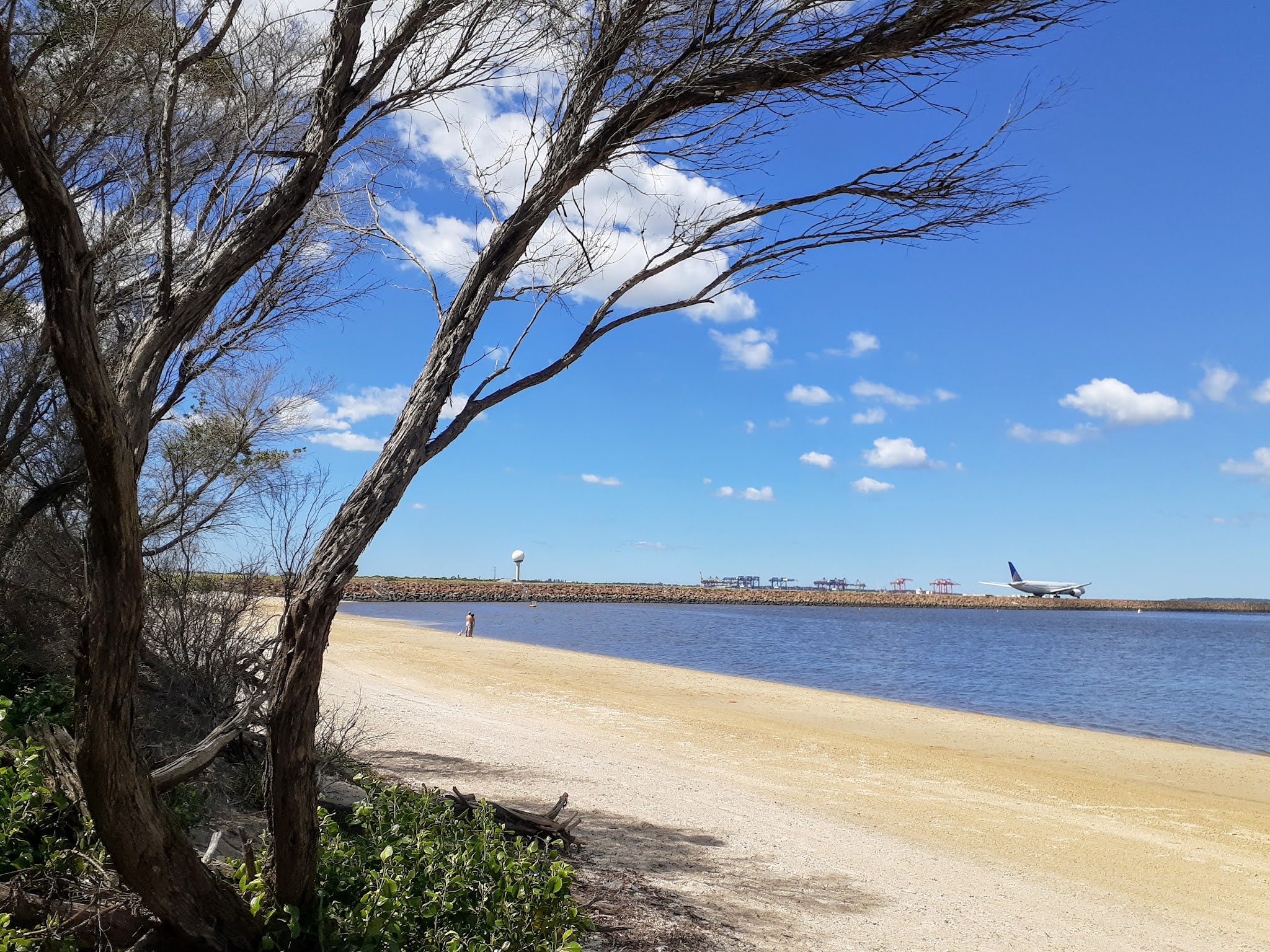
I recoil into my spine as a crackling roar propels across the sky, deafening me in its shadow. The Qantas Boeing 737 barely scrapes me by. It hovers for a fleeting moment, balancing on its crimson tail, passengers waving a last goodbye. Botany Bay sparkles back enticingly, but all too late, the plane sinking evasively into the clouds.

I wade below, in the path of the aircraft, through the waters of The Beach. Otherwise known as Plane Spotting, the 200 metre stretch of sand is jammed between the Cooks River and Sydney Airport by the 34L runway. The water’s brown, muddy, and a little thick, but apparently, it’s safe to swim. Still, I’d rather not dip my head below, not particularly in the mood for the chance taste of jet fuel.

Most people come for the sights instead. Strewn across the shore, aviation enthusiasts recline in camp chairs, eyes fixed to binoculars. They wait hours patiently for the glimpse of a rare registration, marking it down on a score card like a game of bingo.

They’re joined by teams of dog walkers making the most of a relatively empty beach. A few dozen dogs are now disentangled, frolicking leash free. They pause to bark at an incoming Singapore Airlines Airbus A380, landing to kiss the tarmac only metres away. The chase of the pack, defending their ground from the noisy intruder, is held back by a mere wire fence.  


On the other side of Plane Spotting, to the south-west, modest waves lap gently onto Lady Robinsons’ shore. Stretching out in all its glory, the first-class beach is calling me for departure. It’s time I too take flight.

Total Beaches: 60/179

Wednesday, April 7, 2021

Towra Point Beaches (Towra Beach, Elephants Trunk, Taren Spit Beach, Pelicans Point)

Hollow logs and broken branches lay discarded across the sand like fallen antlers, the skeletal remains of once grand beasts. They fade beneath the towering trunks of a new generation, consumed by the sandflats that awaken as the tide retreats. The roots of the mangroves now standing rise through the sand and grasp fresh air. A rejuvenation of greens and yellows sprout to paint the sky. 

Mangroves at Towra Beach

The forest lures me over, away from my kayak and across the expansive shore of Towra Beach. Casts of crabs scutter off as I approach, a rush of blue and orange bodies fleeing for critical shelter. Some pull in their legs and bury themselves desperately underneath a blanket of sand, mistaking me for a hungry heron. They don’t see humans much, the beach only accessible by boat or a paddle from Kurnell.

Lucky for them I bought lunch with me. So, I let them be and pursue a path through the forest floor, each step sinking further into the sand. At its fronter thick banksia-bushland, tea-trees, and tangling tape vines perch above a sand dune, extending beyond the eye into Towra Point. A protected nature reserve and important breeding ground for endangered species, it’s best not to enter.

My footprints lead me back instead to my kayak, left stranded, lost in a desert that yearns for the vanished tide. A long search through wet sand commences, rope dragging the kayak behind, etching into my skin, arms faltering.

Eventually I catch the shallow tide resting above seagrass meadows, a secret underwater garden of gentle green flowers. I wade myself through until I’m back on the sea, welcoming deeper waters as I turn the corner to Elephants Trunk. The odd boat lies anchored along the beach’s elongated strip of low wave-washed sand. Steep sand ridges backed by dense mangrove fields tower over me as I paddle along its shore.

Taren Spit Beach curves around at the end of Elephants Trunk to spray out a saltwater lake. I rest here to float in the lukewarm water, soothing my kayak-ached body. But there’s no real respite from the teasing tide, promptly escaping to leave me exposed. Menacing mudflats, mangroves, and a forest of swamp oak approach me chasing the sea. 

The tide retreats from Elephants Trunk and Taren Spit Beach

I join the chase, one final beach still to conquer, but my kayak is slowing me down. With no other option I leave it to drown in the sludge and continue my journey on foot.

Out of the mudflats formidable sand dunes soon rise before me like ancient pyramids in the Sahara. Signs warn me not to climb up above or else disturb roosting migratory shorebirds. Over thirty protected species visit each summer, flying in from as far away as Siberia, China and Alaska, and are deserving of their rest.

I take a pass through instead, remerging on a labyrinth of oyster shells, iridescent underneath the afternoon sun. My tiptoes navigate their threatening blades protruding in all directions.

A maze of oyster shells

After a series of dead-ends I find my way, a line of washed-up tyres welcoming me on the outer walls of the maze. They point towards Pelican Point, my last beach of desire, across a small stretch of shallow sea. Gunky sand swallows my foot as I try to step my way over. This last stretch will have to be swum.

Tyres point towards Pelican Point

I submerge myself accordingly in the murky, beige water, drifting stray branches gouging at my crawling arms. But my mind stays focused, enticed by the imminent shore. The sparkling white sand rewards me with an embrace as I push through to the other side.

I lie like this for a while, face down hugging the beach, mellow waves lapping at my feet, tiny seashells sneaking in between my toes. Rolling finally on to my side, I watch pelicans soar over tufts of spinifex and coastal wattle shrubs pursuing a lilac, sunsetting sky. The tremendous Captain Cooks Bridge consumes them at the mouth of the Georges River

The retuning tide threatens to consume me too. It's time to fall back for my kayak and home. 

Total Beaches: 59/179


Wednesday, February 17, 2021

Hacking River (Wants Beach & Shallow Rock Reserve)

The emerald waters of the Hacking River flow 42 kilometres north east from deep within the Royal National Park into the estuary at Port Hacking on the outskirts of Southern Sydney. Along the banks sit lush rainforest and eucalypt towered over by sandstone cliffs.


A river rich in wildlife, at shallow depths the spotted backs of jollytail fish poke out, joined by long finned eels, migrants from the ocean. As it deepens turtle shells float on by, splashed occasionally by a hungry platypus diving down for dinner. Azure kingfishers meanwhile observe from branches above, waiting to swoop on prey. Crabs, oysters, and other crustaceans cling to riverside boulders, trying to hide in stillness. The silence is broken only by the chorus of chirping crickets that pervades all over.

Small stretches of sand can be found along the banks at various points but only twice long enough to form proper beaches. First up, Wants Beach at Audley within the national park curves round underneath a stoned wall and picnic area. Yellow-green and silver water reflects the foliage and clouds above, sporadically rippled by the passing of a family of ducks. Toddlers play along the shore amongst the scattered leaves of a forest red gum, their parents watching on from fold up chairs under the shade of the tree's trunk. 

Wants Beach
Rent a kayak from nearby at the Audley Boatshed for a leisurely glide winding downstream to the river’s second beach at Shallow Rock. At the edge of civilisation, houses perch in the trees over the reserve. A popular spot for family picnics, the cries of playing children here merge with the squawks of river herons and visiting seagulls competing for bream and flathead with fishermen’s lines cast from the river’s edge.

The Hacking River extends from Shallow Rock Reserve
This may be the final beach along the river but those who venture further are sure to be rewarded. A small boat ramp here can launch trailer boats, canoes, and kayaks to explore into Port Hacking, where swimming spots are a plenty. Plunge into the netted pools at Gymea Bay and Lilli Pilli before paddling the pristine beaches of Bundeena. I’ll be back soon to continue my quest.  

Total Beaches: 55/179