Featured Post

My Quest to Visit Every Sydney Beach

The Australian beach. A social icon. With 85 per cent of us living by the coast, for many it represents a way of life. A part of our natio...

Showing posts with label Botany Bay. Show all posts

Monday, August 16, 2021

The Beach (Planespotting)


I recoil into my spine as a crackling roar propels across the sky, deafening me in its shadow. The Qantas Boeing 737 barely scrapes me by. It hovers for a fleeting moment, balancing on its crimson tail, passengers waving a last goodbye. Botany Bay sparkles back enticingly, but all too late, the plane sinking evasively into the clouds.

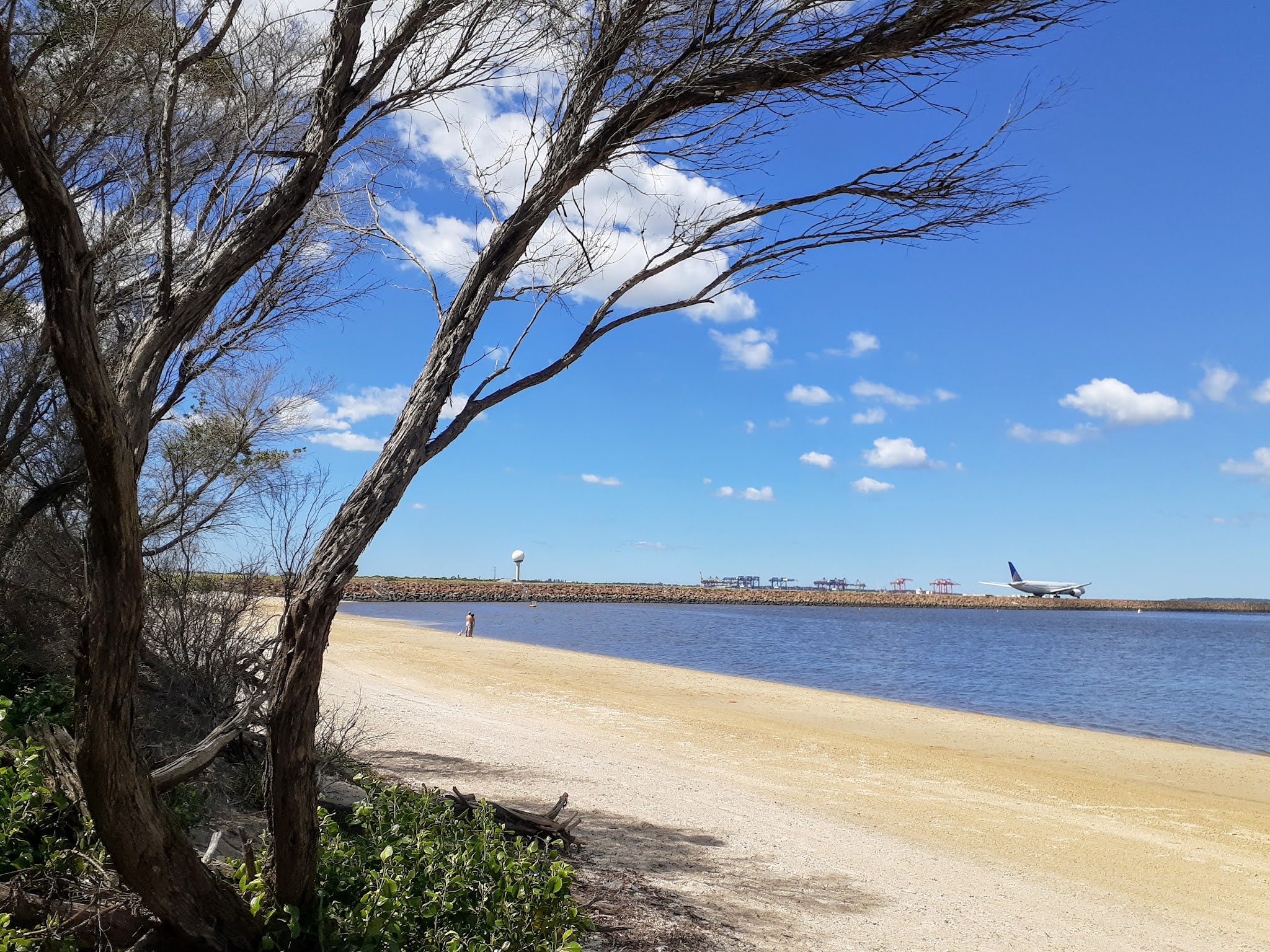
I wade below, in the path of the aircraft, through the waters of The Beach. Otherwise known as Plane Spotting, the 200 metre stretch of sand is jammed between the Cooks River and Sydney Airport by the 34L runway. The water’s brown, muddy, and a little thick, but apparently, it’s safe to swim. Still, I’d rather not dip my head below, not particularly in the mood for the chance taste of jet fuel.

Most people come for the sights instead. Strewn across the shore, aviation enthusiasts recline in camp chairs, eyes fixed to binoculars. They wait hours patiently for the glimpse of a rare registration, marking it down on a score card like a game of bingo.

They’re joined by teams of dog walkers making the most of a relatively empty beach. A few dozen dogs are now disentangled, frolicking leash free. They pause to bark at an incoming Singapore Airlines Airbus A380, landing to kiss the tarmac only metres away. The chase of the pack, defending their ground from the noisy intruder, is held back by a mere wire fence.  


On the other side of Plane Spotting, to the south-west, modest waves lap gently onto Lady Robinsons’ shore. Stretching out in all its glory, the first-class beach is calling me for departure. It’s time I too take flight.

Total Beaches: 60/179

Wednesday, April 7, 2021

Towra Point Beaches (Towra Beach, Elephants Trunk, Taren Spit Beach, Pelicans Point)

Hollow logs and broken branches lay discarded across the sand like fallen antlers, the skeletal remains of once grand beasts. They fade beneath the towering trunks of a new generation, consumed by the sandflats that awaken as the tide retreats. The roots of the mangroves now standing rise through the sand and grasp fresh air. A rejuvenation of greens and yellows sprout to paint the sky. 

Mangroves at Towra Beach

The forest lures me over, away from my kayak and across the expansive shore of Towra Beach. Casts of crabs scutter off as I approach, a rush of blue and orange bodies fleeing for critical shelter. Some pull in their legs and bury themselves desperately underneath a blanket of sand, mistaking me for a hungry heron. They don’t see humans much, the beach only accessible by boat or a paddle from Kurnell.

Lucky for them I bought lunch with me. So, I let them be and pursue a path through the forest floor, each step sinking further into the sand. At its fronter thick banksia-bushland, tea-trees, and tangling tape vines perch above a sand dune, extending beyond the eye into Towra Point. A protected nature reserve and important breeding ground for endangered species, it’s best not to enter.

My footprints lead me back instead to my kayak, left stranded, lost in a desert that yearns for the vanished tide. A long search through wet sand commences, rope dragging the kayak behind, etching into my skin, arms faltering.

Eventually I catch the shallow tide resting above seagrass meadows, a secret underwater garden of gentle green flowers. I wade myself through until I’m back on the sea, welcoming deeper waters as I turn the corner to Elephants Trunk. The odd boat lies anchored along the beach’s elongated strip of low wave-washed sand. Steep sand ridges backed by dense mangrove fields tower over me as I paddle along its shore.

Taren Spit Beach curves around at the end of Elephants Trunk to spray out a saltwater lake. I rest here to float in the lukewarm water, soothing my kayak-ached body. But there’s no real respite from the teasing tide, promptly escaping to leave me exposed. Menacing mudflats, mangroves, and a forest of swamp oak approach me chasing the sea. 

The tide retreats from Elephants Trunk and Taren Spit Beach

I join the chase, one final beach still to conquer, but my kayak is slowing me down. With no other option I leave it to drown in the sludge and continue my journey on foot.

Out of the mudflats formidable sand dunes soon rise before me like ancient pyramids in the Sahara. Signs warn me not to climb up above or else disturb roosting migratory shorebirds. Over thirty protected species visit each summer, flying in from as far away as Siberia, China and Alaska, and are deserving of their rest.

I take a pass through instead, remerging on a labyrinth of oyster shells, iridescent underneath the afternoon sun. My tiptoes navigate their threatening blades protruding in all directions.

A maze of oyster shells

After a series of dead-ends I find my way, a line of washed-up tyres welcoming me on the outer walls of the maze. They point towards Pelican Point, my last beach of desire, across a small stretch of shallow sea. Gunky sand swallows my foot as I try to step my way over. This last stretch will have to be swum.

Tyres point towards Pelican Point

I submerge myself accordingly in the murky, beige water, drifting stray branches gouging at my crawling arms. But my mind stays focused, enticed by the imminent shore. The sparkling white sand rewards me with an embrace as I push through to the other side.

I lie like this for a while, face down hugging the beach, mellow waves lapping at my feet, tiny seashells sneaking in between my toes. Rolling finally on to my side, I watch pelicans soar over tufts of spinifex and coastal wattle shrubs pursuing a lilac, sunsetting sky. The tremendous Captain Cooks Bridge consumes them at the mouth of the Georges River

The retuning tide threatens to consume me too. It's time to fall back for my kayak and home. 

Total Beaches: 59/179

Thursday, January 31, 2019

La Perouse (Cruwee Cove, Congwong, Little Congong, Frenchmans Beach)

Cruwee Cove Beach
From the pink rock pools of Cruwee Cove Beach perched over a deep sea, along the coastal Henry Head Track and down through the trees and bushland, to the two Congwong beaches where light glistens off the ocean like stars in a turquoise sky, these have to be the most beautiful beaches I’ve visited. Oases in isolated coves, protected from the outside world, the area remains untouched, untainted by development, industry and the hustle and bustle of the surrounding Sydney city life. Located in La Perouse, the only Sydney suburb where Aboriginal people have kept their territory from European settlement until today, one is transported back 7,500 years to a natural environment of pre-colonial times. 

It was at this time that sea levels stabilised to form today’s coast for the original owners of the land, the Kameygal. With an abundance of fresh water supplies, fish, and places of natural shelter, the area was ideal for sustained inhabitancy. The Aboriginal people have maintained an unbroken connection. 


But as one walks back up 
the sandy path from Congwong Beach onto the asphalt road, populated car park, and past the monuments, to look out over Frenchmans beach to Port Botany on the horizon, one is reminded of their struggle to do so against a European invasion and imposed modernity.

Indeed, the decision to name La Perouse after the French explorer itself is symbolic of the historic denial of the original indigenous occuparants as owners of the land. Landing on January 26, 1788, passing through on a scientific expedition, La Perouse and his crew stayed in the area for a mere six weeks. 

Congwong Beach

At the exact same time Captain Arthur Phillip and the First Fleet were pulling into Port Jackson to form the first British settlement. Just missing the French, eight days earlier they too had landed in Botany Bay, but finding it unhealthy for settlement due to the swampiness of the area  had moved on to find something more suitable.

Over the next century as the British settlement expanded and Sydney urbanised, Aboriginal camps would come to be scrutinised as a nuisance to white society, increasingly vulnerable to closure. However, with the request of five Aboriginal men and their families honoured by Parliament in 1882, their camps were allowed to stay in La Perouse, justified in that they were economically viable.

Soon the population in the area began to grow as the fishing sites attracted Aborigines from the South Coast seeking employment. This resulted in the decision by the Aborigines Protection Board in 1885 to officially declare seven acres of land at La Perouse a ‘Reserve for the Use of Aborigines' - the only one in Sydney. 

Reserves like these throughout New South Wales were designed to effectively segregate Aboriginal people from white Australia. In La Perouse the Aboriginal people were tied to the reserve through a dependency on government rations and were literally locked in by a fence enclosing the reserve.

This was done to ‘protect’ them from the white community, but its very isolation and absence of white settlement made the area attractive to city residents for weekend day trips. By the turn of the century the Aboriginal residents were participating in the tourist industry selling souvenir boomerangs, woven baskets and shells, while ‘snake men’ would perform in the snake pit. 


George Cann Sr., Snake Handler. Source: https://www.valeriebarrow.com/?p=1360

In 1900 concerns about the interaction between Aboriginal people and white tourists led to a decision by the Aborigines Protection Board to relocate the reserve to the South Coast. But despite ration supplies being phased out, the people refused to move on, and eventually the Board gave in keeping the reserve open.

This
was the first of many failed attempts throughout the 20th century to close the reserve. Each time an emboldened people –fighting for their historical right to live on the land - refused to leave. In 1988 their claim to ownership was finally recognised when the La Perouse Local Aboriginal Land Council was given deeds to the reserve.

La Perouse remains a significant site for many Aboriginal people – symbolic of the people’s continuing connection to their land in the face of colonial invasion. In 1988, after around 40,000 bicentenary protesters from around Australia marched in Sydney from Redfern Oval to Hyde Park, many gathered at La Perouse to both mourn 200 years of violence but also celebrate survival and new beginnings. Funeral wreaths were thrown into the water, fires burned in the dark, and people danced into sunrise.

Survival Day Ceremony

Each year around this time members of the Aboriginal community gather at La Perouse in the celebrattion of their cultural continuity - inviting all to join in. As I watch the cermonial smoke loft up and over the luminescent waters I’m grateful  after everything they’re still prepared to do so.

Total Count: 24/160

For a more detailed history of La Perouse visit The Dictionary of Sydney

Monday, January 14, 2019

Lady Robinsons Beach (Kyeemagh, Brighton Le Sands, Ramsgate, Monterey) & Dolls Point


I’ve started making my way further out, past the airport and into unfamiliar territory. Lady Robinsons Beach on the western shores of Botany Bay stretches between the mouths of the Cooks and Georges rivers. Sydney’s largest beach, it consists of several smaller ones from Kyeemagh in the north through Brighton Le-Sands, Monterey, Ramsgate and extending round the corner at Dolls Point. 

I’ve always known vaguely about it but never thought to visit for a swim.  It’s not that it’s far away. A 20 minute drive straight down the M1, this is actually one of the easier beaches for me to reach. I’ve passed through here a bunch of times on trips down the coast or over to Rockdale for a reminder of my heritage with a Macedonian pastry called burek. But stuck in the honking traffic of The Grand Parade looking across a shore littered with coke cans and Macca’s straws I’ve never found it that appealing. Planes departing over an industrial shipping port are not the view you expect from a Sydney beach. It’s far from the picturesque ocean waves crashing onto golden shores or the cityscape viewed from harbour coves. 

This time I decided to stop and easily found a place in one of the many ample car parks. At Kyeemagh across the scorching sands I bounced through a maze of tents and beach umbrellas. I cooled off with a splash in the gentle shallow waters of the netted baths. Lazing in the afternoon sun even the odd passing plane couldn’t ruin the tranquil mood. 

But as I made my way south to Brighton Le Sands I was in for something else. Busy and noisy, right on the main road, I had made it to the real party. Cars zoomed past busy restaurants and bars, Nicki Minaj thumping. Speed boats raced across the water dragging wake surfers behind them. Wind surfers glided along the horizon, kite surfers launching out and above them.

Most conspicuously though on jet skis bearded, buff dudes with gold chains and fluro-coloured board shorts were flexing to each other. My distant wog cousins, this could easily have been me in another life. I was far from the Eastern Suburbs beaches and their blonde blue-eyed locals.

Rather this area hosts large Southern European and Lebanese communities and an easy access down the M5 from Western Sydney attracts visitors from the further diverse communities out that way. 

With them they bring their delicious culinary delightsAs you make your way further down the Lady Robinsons promenade the scents of roasting lambs and grilling freshly caught fish waft over from large families barbecuing under the pines behind in Cooks Park. 

Dolls Point
By the time I made it to the more peaceful and family-oriented Dolls Point, a large section of sand curving outwards into the Georges River mouth, I could no longer take such tantalisation. A sprint to my car and I was soon back in Brighton spoilt for choice with Greek spots. A wolfed down haloumi gyros and I was on my way home detouring via Rockdale for burek.
Burek
Total Count: 20/160

A special thanks to Rena Zheng accompanying me on this one. All photos (except the Dolls Point and burek ones) belong to her copyright 2019. You can view her further photography work here


Thursday, December 13, 2018

Foreshores Beach


I tread in the shadow of shipping containers piled to the sky. Slimy sand oozes between my toes. Acidic waters singe my skin. My ears cannot escape the constant thunder of trucks passing behind and planes above.

I’m at Foreshores beach. Squeezed between Kingsford Smith Airport and Port Botany, it’s Sydney’s most polluted. The only spot to be given a ‘very poor’ rating by a government report ranking cleanliness of NSW beaches and swimming sites, indicating a high susceptibility to faecal contaminations from sewage overflows and therefore unsuitable for swimming. A few years ago it even turned orange. Still no one knows why.

Picture: Brett CostelloSource: News Corp Australia

You technically are allowed to swim here though as long as it hasn’t been raining recently – a little surprising given Sydney’s overprotective rules and regulations. That’s better than the Cooks River on the other side of the airport. One of the most polluted waterways in Australia, it’s been closed to swimmers for over 80 years due to a regular influx of rubbish, industrial toxic waste, and sewage from more than 150 overflow points. From early on in the colonial years, once Sydney Harbour was chosen as the more suitable place for white settlement, Botany Bay quickly became the industrial heartland, the river’s side especially exploited for both its water resources and dumping grounds. 

Milica didn't seem to mind.
In all honesty though, the beach is nowhere near as bad as the river. Without the industrial shipping backdrop and surround sound of roaring engines it would actually be quite pleasant. Shell-layered white sand dunes merge with light blue crystalline waters. Unleashed visiting dogs frolic on the shallow shore. The fact it borders an airport even gives it a sort of novel charm as pelicans depart and land in tandem with jumbo jets in the distance.
That’s not to say I’ll necessarily be back here any time soon, with much better options nearby still to explore, but it definitely isn’t as bad I was expecting. I don’t know - maybe I just came on a good day.


Total Count: 9/160